


Need Help?
Call an heating expert on 01282 429061

 PayPal Spread The CostKlarna, Clearpay or PayPal
 Free DeliveryOrders Over £500Excludes boilers and worktops
 Price Match PromiseWe won't be beaten on price
Need Help?
Call an heating expert on 01282 429061
Solid wood worktops are supplied sanded and bare. TopOil is the finish that makes them usable: two coats, applied before the boards go in, and the surface repels water, resists everyday spills and stays repairable for the life of the kitchen.
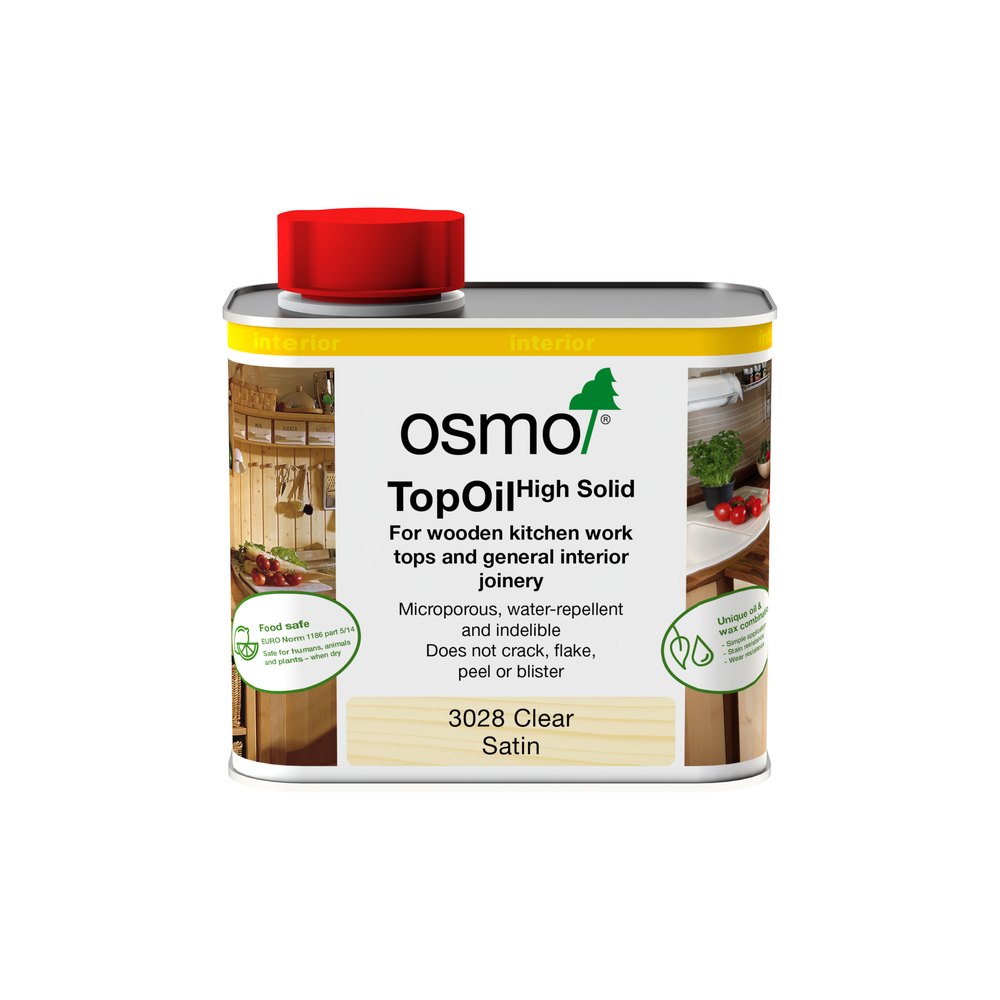
Osmo TopOil is a hardwax oil for interior worktops. Two coats give a food-safe, water-repellent surface that soaks into the timber instead of sitting on top, so it never peels and a worn patch can be re-oiled on the spot. A 500ml tin covers about 15 square metres per coat, which is enough for a typical three-board kitchen.
Every solid wood worktop we sell arrives sanded and unfinished. That is deliberate - it lets you cut, join and shape the boards on site, then finish the whole run including the fresh cut edges, which is where water actually gets in.
TopOil is a hardwax oil, not a varnish. It penetrates the timber and cures inside it. A varnish forms a film on the surface, and when that film is scratched or lifts, the only fix is stripping the whole board. An oiled surface has no film to break, so a scuff or a water mark is repaired by cleaning the spot and brushing more oil into it.
All five tins are the same oil with the same protection. The difference is what they do to the colour of the wood.
| Finish | What it does |
|---|---|
| Clear Satin | the default choice - a low-sheen finish that darkens the timber slightly and looks like oiled wood rather than varnish |
| Clear Matt | the same protection with almost no sheen, for a raw, modern look |
| Natural Matt | carries a white pigment that cancels the yellowing oil normally causes, so pale timbers stay pale - the one to use on ash and beech |
| White Satin | a white-tinted finish for a limed, Scandinavian look on pale timber |
| Terra Transparent Satin | a warm brown tint that deepens the grain on oak and walnut |
Osmo state coverage of 30 square metres per litre for a single coat, so a 500ml tin covers roughly 15 square metres once, or 7.5 square metres finished at the two coats a worktop needs. Measured against our own worktop sizes, that works out as follows.
| Board | Surface area | Two coats needs | Tins |
|---|---|---|---|
| 2m x 635mm worktop | 1.27 m2 | 2.54 m2 | one 500ml tin does 2 boards |
| 3m x 635mm worktop | 1.91 m2 | 3.81 m2 | one 500ml tin does 1 board, twice over |
| 4m x 635mm worktop | 2.54 m2 | 5.08 m2 | one 500ml tin per board |
| 3m x 960mm breakfast bar | 2.88 m2 | 5.76 m2 | one 500ml tin per bar |
| Typical 3-board kitchen | 5.72 m2 | 11.44 m2 | two 500ml tins, with some left |
Two. The first coat soaks in and raises the grain slightly, the second seals it. Oil the underside and every cut edge as well, especially around a sink cut-out - that is where water reaches the timber and where boards fail first.
8 to 10 hours between coats in a ventilated room. The surface is usable the next day, but it takes 2 to 3 weeks to cure fully, so avoid soaking it or leaving anything wet on it during that period.
Yes, once cured. It is certified to EN 1186 for food contact and EN 71.3 for children's toys, which is why it is the standard finish for kitchen worktops and chopping boards.
Natural Matt 3068. Clear oils deepen pale timber to a honey tone; 3068 carries a white pigment that cancels that, so beech and ash keep the pale look you chose them for.
Once a year for a normal kitchen, and sooner around the sink and hob where the surface works hardest. A worn area shows itself simply - splash it with water, and if the water soaks in and darkens the wood rather than beading on it, that patch is due.
Yes. Clean it, let it dry, and apply as normal - you can re-oil in place at any point. The only thing you cannot do in place is get to the underside and the cut edges properly, which is why the first oiling is always done before the boards go in.
Buying oil for a new worktop? The solid wood worktop range ships sanded and unoiled, so it needs this before it goes in.